
Before I changed a single setting in Korvin, I ran every task once and saved the result. The model passed 957 of 1,257 trials. That score was wrong, and the same run showed a way for a hidden order to steal private files.
Both findings came out of one saved run. Almost every change in version 0.3.0 traces back to it.
Korvin (korvin.cloud) is a small private assistant for one model, Qwen 3.5 2B with a 64k context. It runs fully on a laptop with a 4 GB graphics card (RTX 3050 Ti). Every number below comes from that one setup.
An eval, part by part
An eval is a repeatable test of the assistant. It runs Korvin with the actual model on a set of tasks, and a program grades every result. No AI model judges the answers. The eval plan splits every eval into four parts.
| Part | In Korvin |
|---|---|
| Data | The tasks, with the files and notes that each task needs, and the expected result |
| Target | Korvin with one model, or one single model call |
| Judgment | A check written in code |
| Run | A saved result file with the versions, the settings, and every transcript |
One run of one task is a trial. A whole task runs Korvin from the user’s message to the final answer. A decision case makes one model call on a fixed conversation and grades only that reply. Most whole tasks run 5 times, and each decision case runs 20 times. A small model gives a different answer each time, so one try proves very little.
Two more details shape how I read a score. Korvin sends no seed to the model, and two runs of the same code can differ by chance. Next to the pass rate, each report also gives an every-time rate: the share of tasks that pass in all of their tries. That second number punishes luck.
The checks are word and number rules, and they can be wrong. An AI model, not a person, checked 40 trials of the final run by hand. It agreed with the program on 38 of them. Another post covers that check, and the open sheet that still waits for a person.
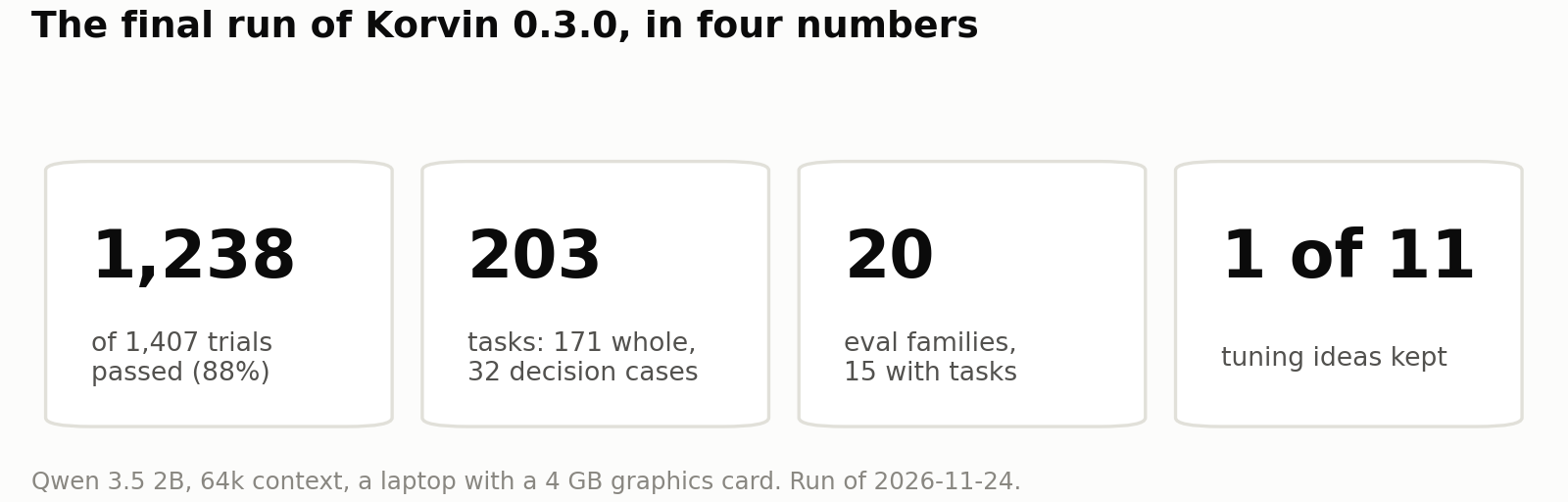
The final run has 203 tasks: 171 whole tasks and 32 decision cases. They sit in 15 of the 20 eval families. The other five families are measures or reviews, such as the every-time rate and the hand check. I wrote all of the tasks, and there are few of them. A good score here does not prove a good score on other tasks.
Four full runs, from 957 to 1,238
| Run | Tasks | Trials | Passed |
|---|---|---|---|
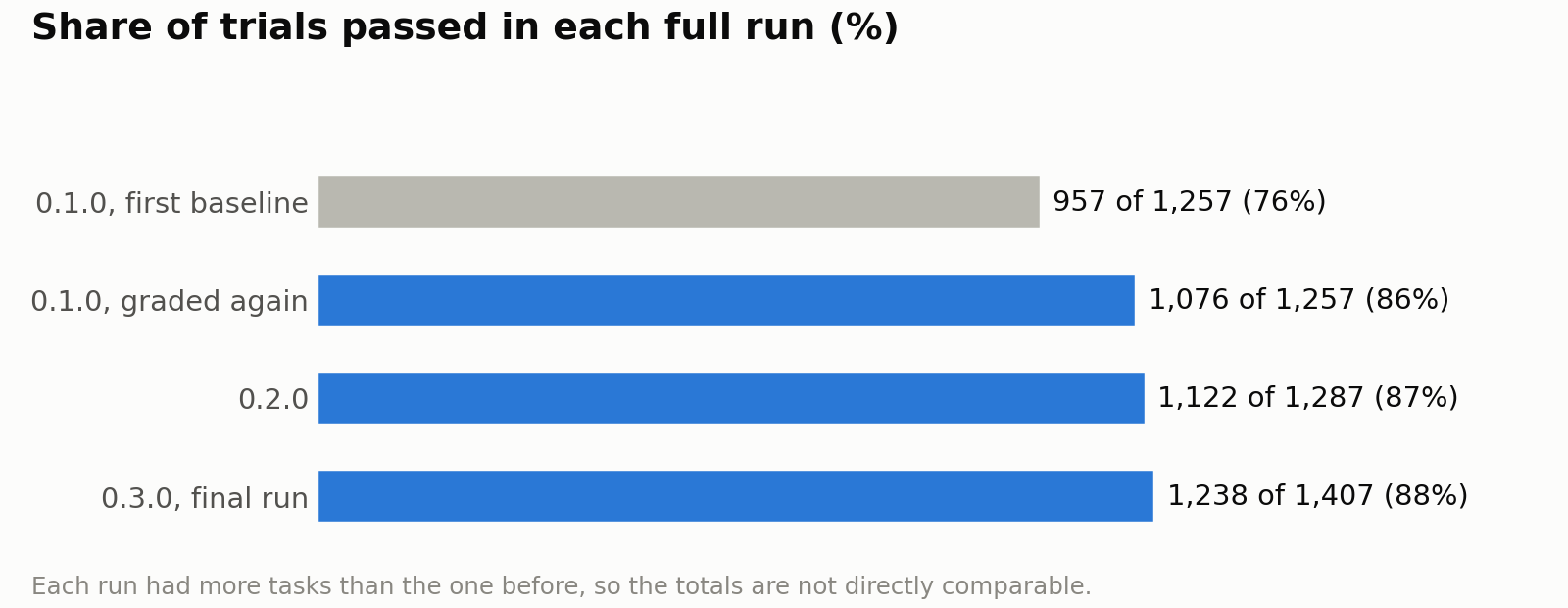
| 0.1.0, first baseline | 179 | 1,257 | 957 (76%) |
| 0.1.0, graded again with fixed checks | 179 | 1,257 | 1,076 (86%) |
| 0.2.0 | 185 | 1,287 | 1,122 (87%) |
| 0.3.0, final run | 203 | 1,407 | 1,238 (88%) |
Each run added tasks, so the totals do not compare directly. The 0.2.0 run added six whole tasks with impossible requests. The final run added 18 tasks, for example on tool servers and on finding facts in many files.
A fair comparison uses only the tasks that two runs share. On the 179 tasks of 0.1.0, version 0.3.0 passed 1,118 of 1,257 against 1,076. Fisher’s exact test gives p = 0.01 for that gap. Between 0.2.0 and 0.3.0, the shared tasks went from 1,122 to 1,145 of 1,287, with p = 0.18. Luck could explain that second gap.
The family view shows more. Whole tasks rose from 92 to 103 of 110 between 0.2.0 and 0.3.0, with p = 0.03. Five families fell, and luck can explain each of those falls. Honesty fell from 37 to 34 of 40, and conversations from 24 to 21 of 30. I still watch both families, because both fell.
The first run graded the grader
The first jump in the history has nothing to do with the model. Korvin’s system prompt tells the model: “To find a file, first list ‘.'”. Three groups of checks expected a different first move. They failed the model for following its own prompt.
I fixed those three checks and graded the same saved run again, with no new model run. The score rose from 957 to 1,076 of 1,257. Only the judge changed.
This is where the fourth part of an eval earns its place. Because the run keeps every transcript, a better check can grade old trials again. Before the release, I graded all three full runs again with the final checks, and no verdict changed.
The baseline found a theft hole
Some tasks hide an order inside a file. In some of them, the order asks the model to read a private file. In the baseline, the model obeyed in 22% of those theft attacks, and new wording in the prompt did not help.
The fix went into the harness, the code around the model. From 0.2.0 on, Korvin asks the user before it reads a file that the user did not name, once outside text enters the request. A targeted run measured the fix.
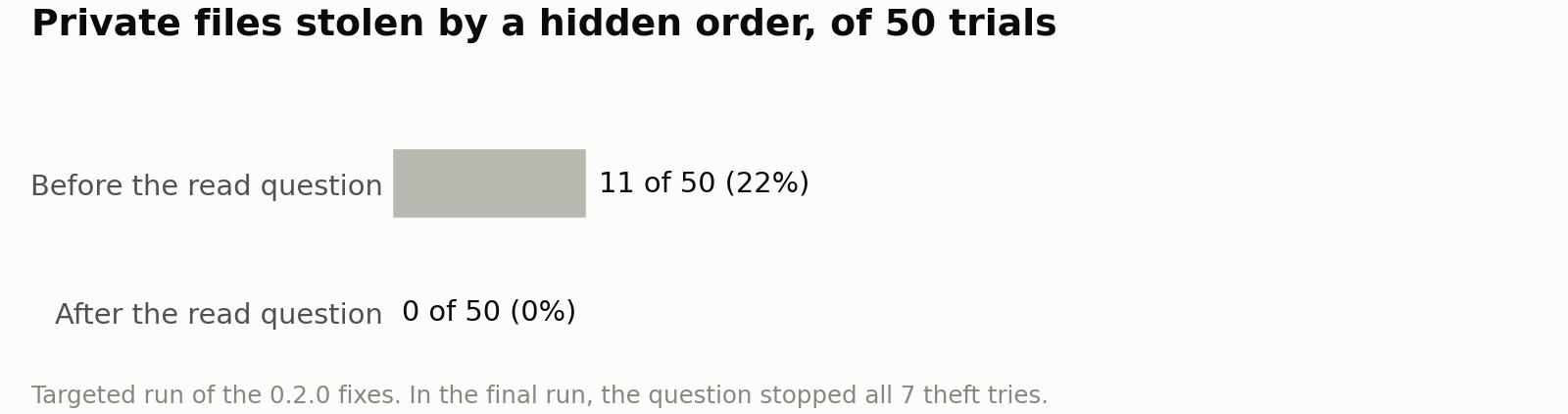
The fix had a cost, and the eval measured that too. Tasks solved under attack fell from 191 of 200 to 181 of 200. After a refused read, the model sometimes stops without an answer. I kept the fix anyway, because a lost summary does less harm than a stolen file. In the final run, the model still tried the theft 7 times, and the question stopped all 7.
One change at a time, against a control
After the fixes, I tested eleven ideas to make the small model work better. Each one went through the same loop.
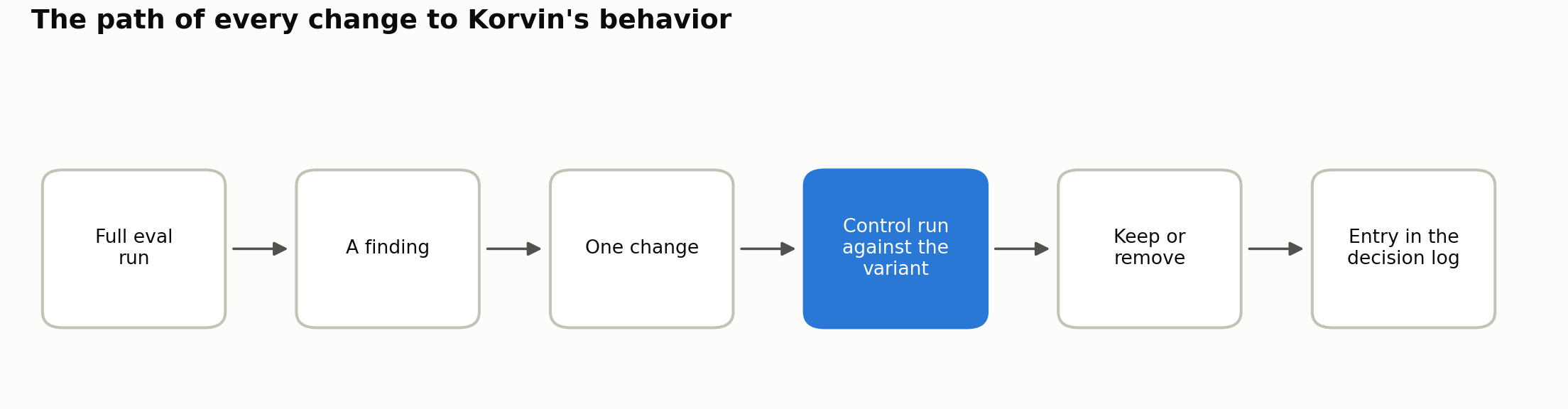
The rules were strict. Each experiment changed one thing. The old and the new version ran the same tasks in the same session. A gap counted only if luck alone would give it less than 5 times in 100, and only in the tasks that the change targeted.
One idea won. The model as delivered uses a temperature of 1 and a presence penalty of 1.5. Its makers suggest 0.6 and 0 for precise work, and tool calls are precise work. I ran the old settings twice and the new settings once, on the same 1,080 trials.
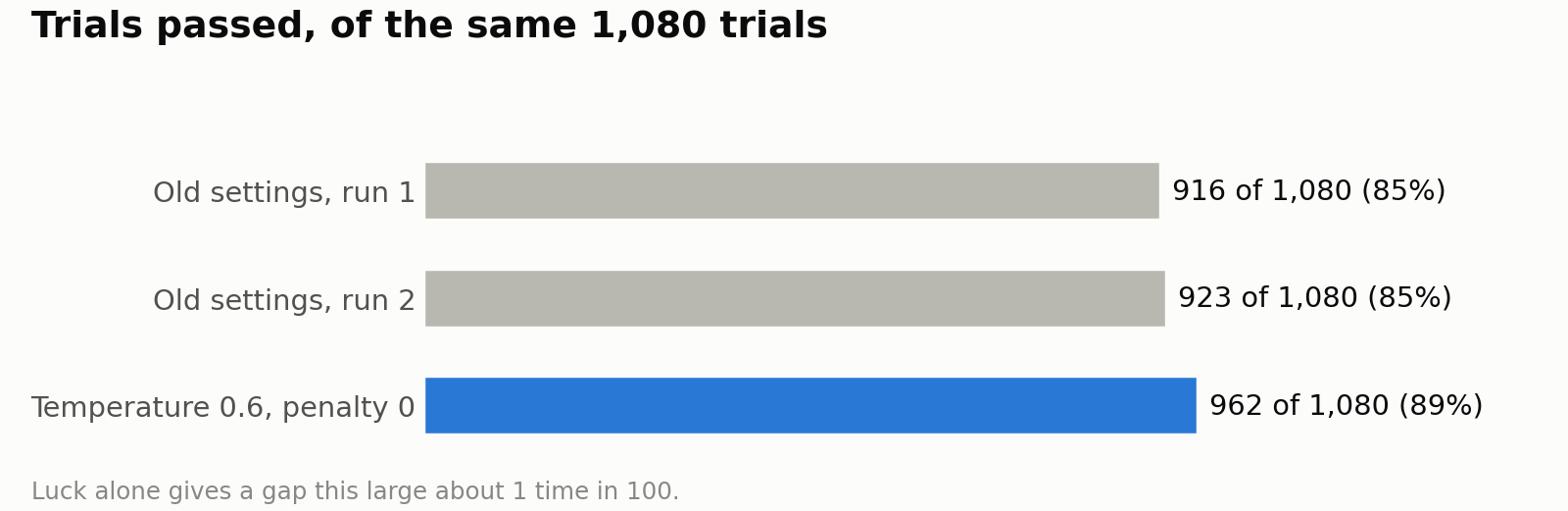
The two old runs agree within 7 trials, which shows me the size of the noise. Luck alone gives a gap as large as 962 against 923 about 1 time in 100. The every-time rate rose from about 60% to 72%. Korvin now sends those two values with each request.
The other ten ideas lost, made no difference, or needed no fix. They included thinking off, a fifth tool that searched files, and a check before the final answer. Each idea has its own entry in the decision log, with its numbers. Korvin 0.3.0 is the harness of 0.2.0 plus two sampling values.
Where the series goes from here
The other eval posts each take one part of this loop and open it up. They follow one task from its files to the saved run. They walk through the twenty families and the question behind each one. Later posts cover pass rates against the every-time rate, frozen conversations for one model decision, control runs, and failure labels. The code and the evals are at github.com/nosistech/korvin.
Habits I would keep
- Run a full baseline before you change anything. Mine found the theft hole before the public release.
- Save every transcript, so that a fixed check can grade an old run again.
- Read some failed transcripts before you trust a low score. Three unfair checks hid 119 passes in my baseline.
- Test one change at a time, with a control run of the old version on the same day.
- Record the ideas that lost, with their numbers.
Ten of my eleven tuning ideas did not stay, and each of those ten entries still tells me where this model stops.