
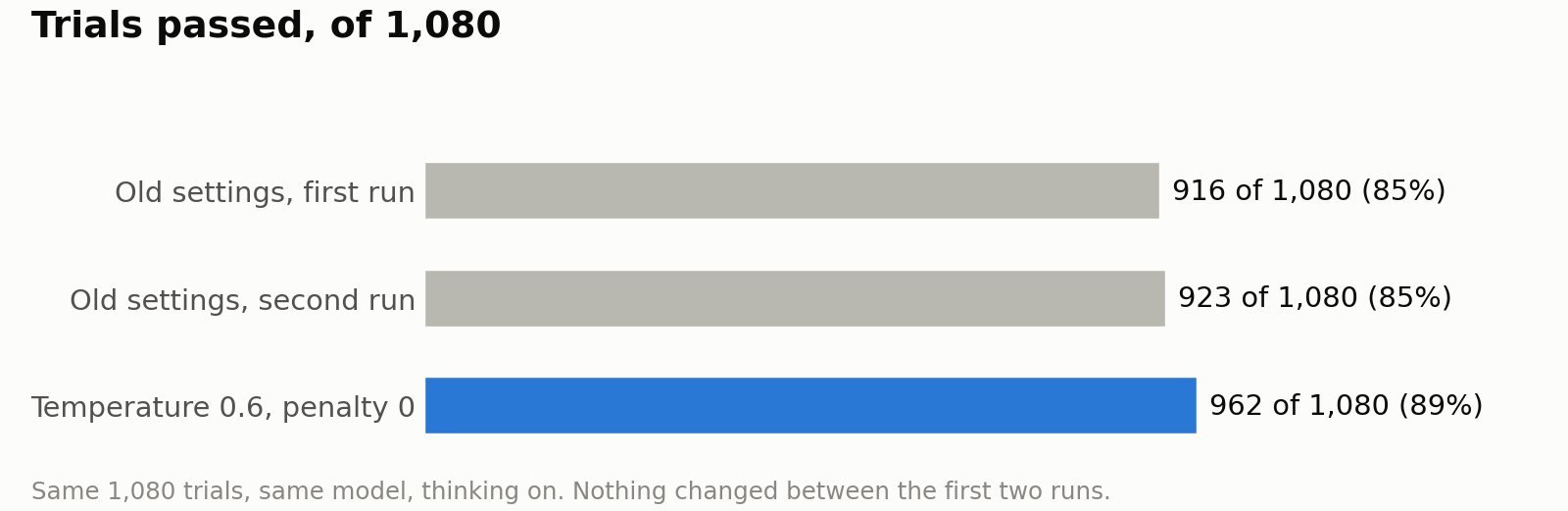
I ran Korvin’s old sampling settings twice on the same 1,080 trials. Nothing in Korvin changed between the two runs. The first run passed 916 trials and the second passed 923.
Seven trials of difference came from chance alone. A small model gives a different answer on each run, and Korvin sends it no seed. Without that second run of the old settings, I could have called almost any small gain a win.
Korvin is a small private assistant for one local model, Qwen 3.5 2B, with a 64k context on a 4 GB graphics card. I tested eleven tuning ideas on it with evals. An eval here is a fixed set of tasks that runs the assistant many times, and a program grades every result. One idea of the eleven stayed.
The rule and the four terms behind it
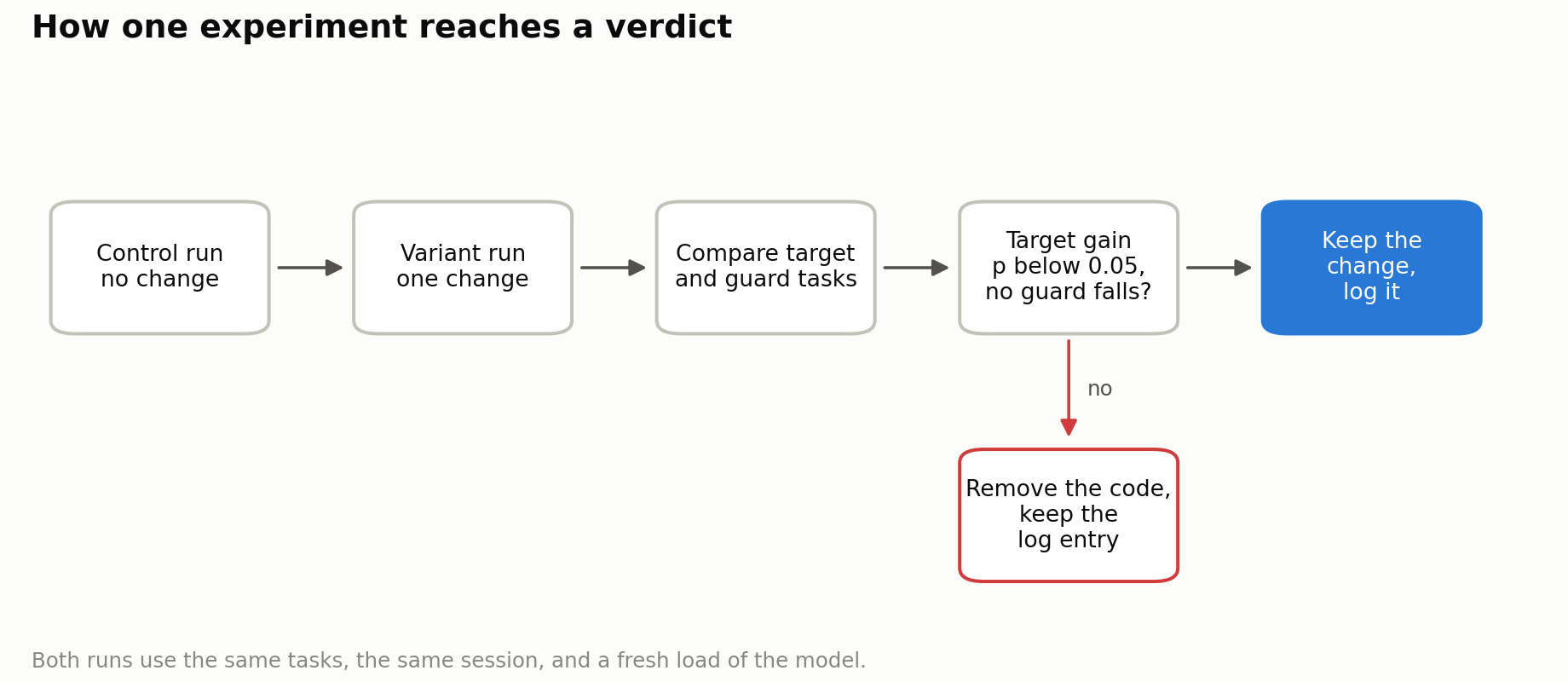
The rule comes from the entry “Measure first” in the decision log:
- Record the baseline score before any tuning.
- Test one change at a time.
- Keep the change only if the score rises.
A fair comparison needs exact terms, and I fixed four of them.
| Term | Meaning in Korvin |
|---|---|
| Control | The current version, with every experiment switch off |
| Variant | The same version, with one change switched on |
| Same tasks | Both versions run the same task list and the same trial counts |
| Same model state | Same model, same Ollama version, same session, and a fresh load of the model before each run |
The fresh load is there because Ollama keeps up to 8 GB of old requests in memory.
Before each experiment, I named two kinds of tasks. Target tasks are the ones that the change should improve. Guard tasks cover safety, honesty, and everyday chat. A change that hurts a guard does not stay, even with a gain on its target.
A statistical test then compares the two counts. Its “p” value is the chance that luck alone gives a gap this large. I accept a gap only when p is below 0.05 and the gap sits in the target tasks.
In these experiments, most whole tasks ran 10 times in each version. Single-step evals, which grade one model reply, ran 20 or 40 times. At those counts, a gap of a few trials stays inside chance.
Eleven ideas against their controls
Ten ideas changed Korvin’s behaviour. The eleventh measured speed over several turns. It found nothing to fix, so it changed no code.
| Idea | Control | Variant | Gap | p | Result |
|---|---|---|---|---|---|
| A special message after a refused read | 262 of 320 | 251 | -11 | not given | Removed |
| Thinking off | 916 of 1,080 | 842 | -74 | far below 0.001 | Thinking stays on |
| Temperature 0.6, presence penalty 0 | 916 and 923 of 1,080 | 962 | +39 against 923 | about 0.01 | Kept |
| Read a named file directly | 457 of 500 | 460 | +3 | not given | Removed |
| Ask when a request is unclear | 580 of 640 | 579 | -1 | not given | Removed |
| The chat format of Qwen 3 Coder | 1,050 of 1,170 | 905 | -145 | below 0.001 | Removed |
| One worked example in the prompt | 1,050 of 1,170 | 1,072 | +22 | 0.12 | Removed |
| A narrow finish check | 438 of 490 | 426 | -12 | 0.24 | Removed |
| A fifth tool that searches files | 650 of 736 | 648 | -2 | 0.9 | Removed |
| Keywords for notes | 157 of 180 | 155 | -2 | 0.76 | Removed |
| Speed over several turns | no code change | No fix needed |
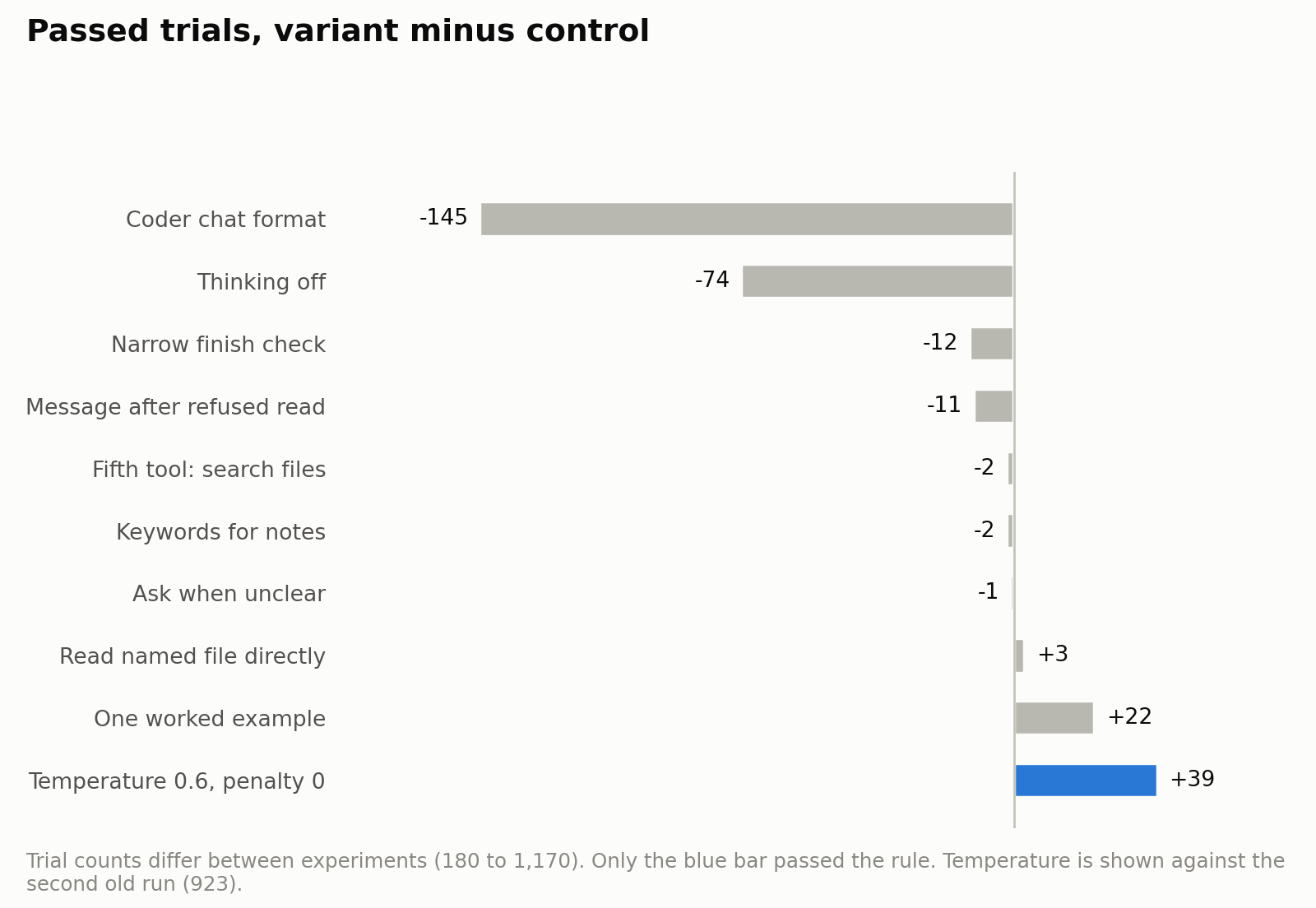
The temperature change was the only winner. The log puts the chance of a gap that large at about 1 in 100. Against both old runs together, it is about 2 in 1,000. Chains of files rose from 46 to 57 of 60. The share of tasks that passed all of 5 tries rose from 61% to 72%.
That winner had a cost too. For requests that Korvin cannot do, it passed 108 of 120, against 115 and 118 in the two old runs. In most of those failures, the model searched the notes for the weather.
One control for two experiments
The coder chat format and the worked example shared one control run. I allowed that only because the tasks and the settings were the same.
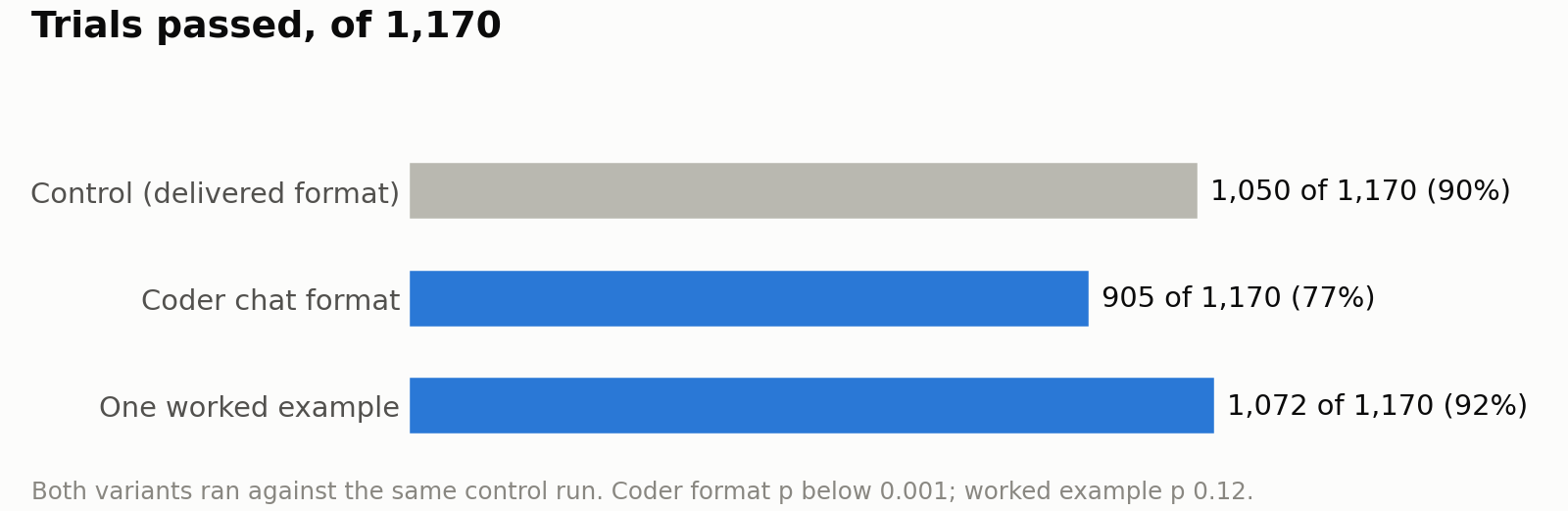
The coder format lost by 145 trials. With it, the model often wrote “I have saved your note” and called no tool.
The worked example was harder to judge. It passed 1,072 against 1,050, but p was 0.12. Its target, chains of files, moved from 55 to 58 of 60, with p at 0.24. One guard also fell. In n-followup, the answer is already in the chat. With the example, the model listed the folder in 8 of 20 trials, against 2 of 20. I removed it.
Inside the losses
Two ideas were new sentences in the system prompt. With “read a named file directly”, the model listed the folder 35 times in 130 trials, against 75 before. Its route changed, yet it passed almost the same number of trials, and tasks got no faster. With “ask when a request is unclear”, the target stayed at 124 of 150 in both versions.
The special message after a refused read did nothing for its target: 52 against 53 of 80. In the attacks that try to steal a file, it did worse, 85 against 93 of 100. Luck gives a gap that large about 7 times in 100, so this shows no gain without proving harm.
The finish check got answered as if it were the user. My first wording asked “Is the request fully answered?” That run stopped at 346 of 530 trials when the computer ran low on memory. By then, 144 answers repeated the check.
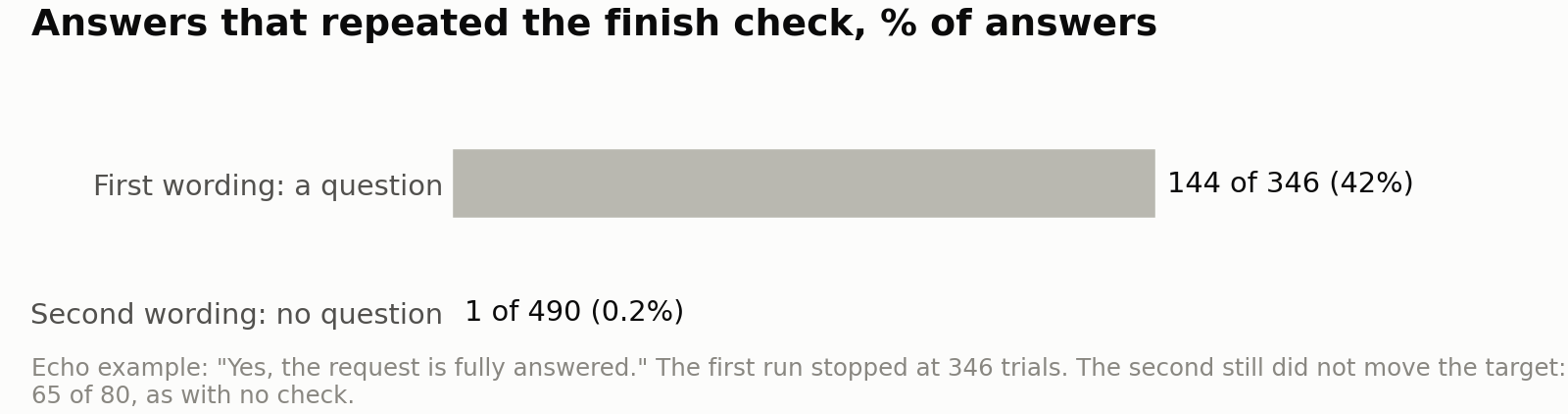
A narrower check without a question fixed the echo: 1 answer in 490. Its target still stayed at 65 of 80, the same as with no check.
With search_files as a fifth tool, the model wrote 4 broken tool calls. When no file held the fact, it searched again and again until the 8-step limit. It often searched one word at a time, such as “bin”, and missed “Rubbish”. The target moved from 26 to 25 of 60.
Note keywords failed for a different reason. The model added 779 keyword words, and only 118 were not already in the note. It wrote “eye exam, Dr. Halloran, Friday” and never “optician”. The target rose from 37 to 39 of 60, within chance, while the note tasks fell from 120 to 116 of 120.
What happens to an idea that loses
A lost experiment stays on record. Each one went through the same five steps.
- The decision log gets an entry with the question, the options, and the full table of numbers.
- The status line says that the change failed, for example “The change failed, so the system prompt stays as it was.”
- The code, its switch, and its tests are removed.
- Useful new eval tasks stay. Families 19 and 20 came from the search tool and the keyword tests.
- Side effects get written down without a claim.
The worked example gives a case of step 5. With it, the model asked which report the user meant in 18 of 20 trials, against 6 of 20. I did not test the example for that goal, so I claim nothing yet.
The log never deletes or rewrites an entry. A changed mind gets a new entry.
Running the same test on your own model
- Run a control and a variant on the same tasks, in the same session.
- Unload and reload the model before each run.
- Name your target tasks and guard tasks before you look at any result.
- Pick a test that gives a p value, and set your limit in advance.
- Once, run the old settings twice, to see how far chance moves your totals.
- Write down every loser with its numbers.
All of these experiments ran on one model, one laptop, and Ollama 0.40.17. A different model would need its own full run and its own experiments.
The round closed with a short entry. Korvin 0.3.0 is the 0.2.0 harness plus two sampling values.