
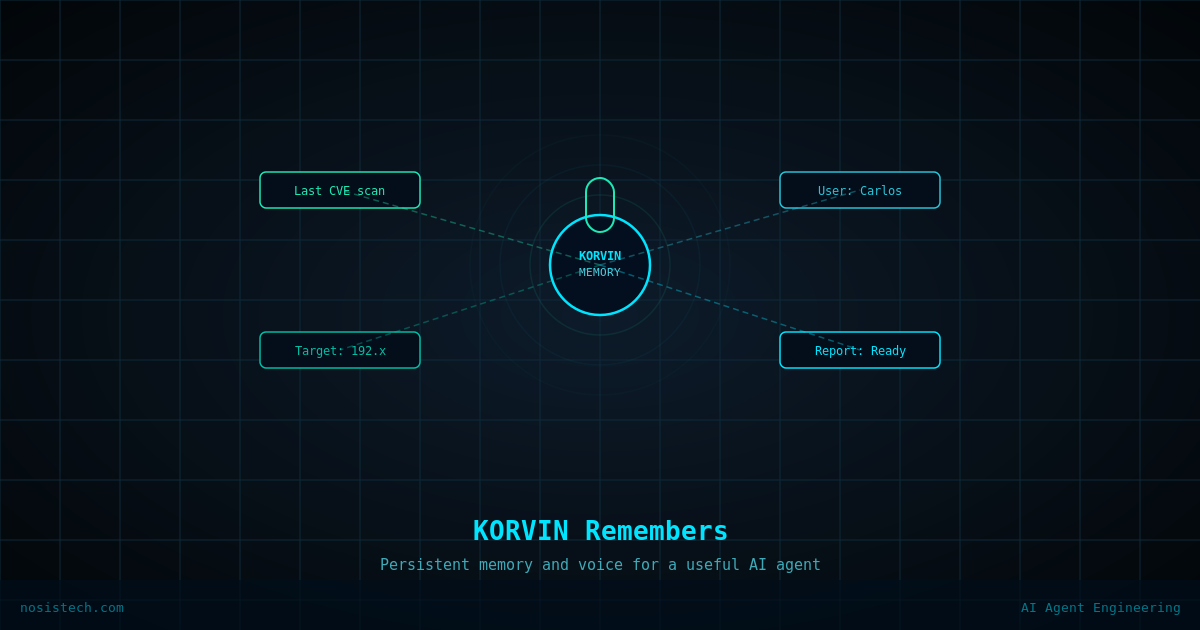
An AI agent that remembers who you are, what you asked yesterday, and answers back in a human voice, built for personal use, running on modest hardware, entirely open source.
Disclaimer: This article documents a personal technical experiment on my own infrastructure. The configurations, rules, and steps described reflect what worked in my specific environment and should not be treated as security advice, professional recommendations, or guaranteed protection against any threat. Every environment is different. Always validate independently, test in a non-production setting first, and consult qualified security professionals before applying any security-related configuration to production systems. NosisTech LLC accepts no liability for outcomes resulting from use of this content.
Most AI assistants forget you the moment the conversation ends. Every session starts from zero — no context, no history, no awareness of what you discussed yesterday or what you asked last week. For a personal AI security agent that is supposed to work with you over time, that is a fundamental design flaw. KORVIN was built differently.
Memory That Persists
KORVIN stores every conversation in a local SQLite database running on the same VPS as the agent. This is not cloud-synced memory, not a third-party service, and not dependent on any external platform staying online. It lives on my infrastructure, under my control, and it persists across sessions indefinitely.
What this means in practice is that KORVIN builds context over time. It knows what was discussed in previous sessions. It can reference earlier queries, track ongoing topics, and carry awareness of your situation from one conversation to the next. That continuity is what separates a genuinely useful AI assistant from a chatbot that resets every time you open it.
The memory implementation is deliberately lightweight. SQLite requires no separate database server, no configuration overhead, and no additional infrastructure. It runs as a single file on the VPS and handles the memory requirements of a personal AI agent without any of the complexity of enterprise database systems. That keeps KORVIN fast, portable, and easy to maintain.
Currently I am working on expanding the memory system to include smarter context windowing, automatically prioritizing the most relevant past conversations when building responses, and a searchable memory interface accessible through the dashboard. Both are active development items.
Voice That Works
I built KORVIN because I do not like to type. That sounds simple but it drove every design decision in the voice stack. The goal was an AI agent I could talk to and that would talk back, naturally, clearly, and without requiring me to look at a screen.
The voice stack combines two open source components. Speech-to-text converts spoken input into text that KORVIN can process. Text-to-speech converts KORVIN’s responses back into natural-sounding audio. Both run locally on the VPS. There is no cloud API dependency, no per-request cost, and no latency introduced by routing audio through an external service.
The result is a genuinely conversational experience. I speak, KORVIN listens, processes, researches if needed, and speaks back. The voice is clear and natural, not the robotic synthesis that defined earlier TTS systems. It is the kind of voice you can actually listen to for extended periods without fatigue.
This matters more than it might seem. An AI assistant you have to type to is a tool you use when you are at a desk, focused, and willing to stop what you are doing to interact with it. An AI assistant you can talk to is a tool you can use while doing something else, walking, reviewing physical infrastructure, driving, or simply when you want information without interrupting your workflow. That is a fundamentally different level of utility.
Hands-Free by Design
The combination of persistent memory and voice is what makes KORVIN genuinely hands-free. You do not need to open an app. You do not need to type a query. You do not need to remember what you asked last time. You speak, KORVIN responds, and it already knows the context of your ongoing work.
KORVIN currently operates through Telegram as its primary interface, which means the voice interaction works from any device that runs Telegram, phone, tablet, desktop, or any combination. WhatsApp, Discord, and Signal support are in active development, which will extend that flexibility further.
Why Local Matters
Running memory and voice processing locally rather than through cloud APIs was a deliberate choice. Personal AI infrastructure that routes your conversations and voice input through third-party servers creates data exposure you cannot fully control. Local processing means your queries, your voice, and your conversation history stay on your own infrastructure.
For a security agent specifically, that distinction matters. The conversations KORVIN has are often about vulnerabilities, infrastructure configurations, and threat research. That is not data I want leaving my environment by default.
Local processing also means KORVIN works on modest hardware. The voice stack and memory system run comfortably on a standard VPS without GPU requirements or enterprise compute. That was a core design constraint from the beginning — if it cannot run on hardware most people already have, it is not built for the real world.
Keep reading: KORVIN
Previous article: KORVIN’s Live Dashboard: Real-Time Infrastructure Awareness From Anywhere in the World
Next article: Why KORVIN Removed Docker Sandboxing and What We Learned
All articles: NosisTech Writing